
Many backlink analyses start with a simple number: How many backlinks does a domain have?
At first glance, this number seems clear. In practice, however, it is often less meaningful than it appears. A website can have a very large number of individual links without receiving recommendations from many different sources.
A typical example is sitewide links. If a domain is linked from a footer, sidebar or navigation, this can quickly create a very high number of individual backlinks. Technically, these are many links. In terms of source diversity, however, they often come from a single linking domain.
This is why Domainpop is often more useful than pure Linkpop in many analyses.
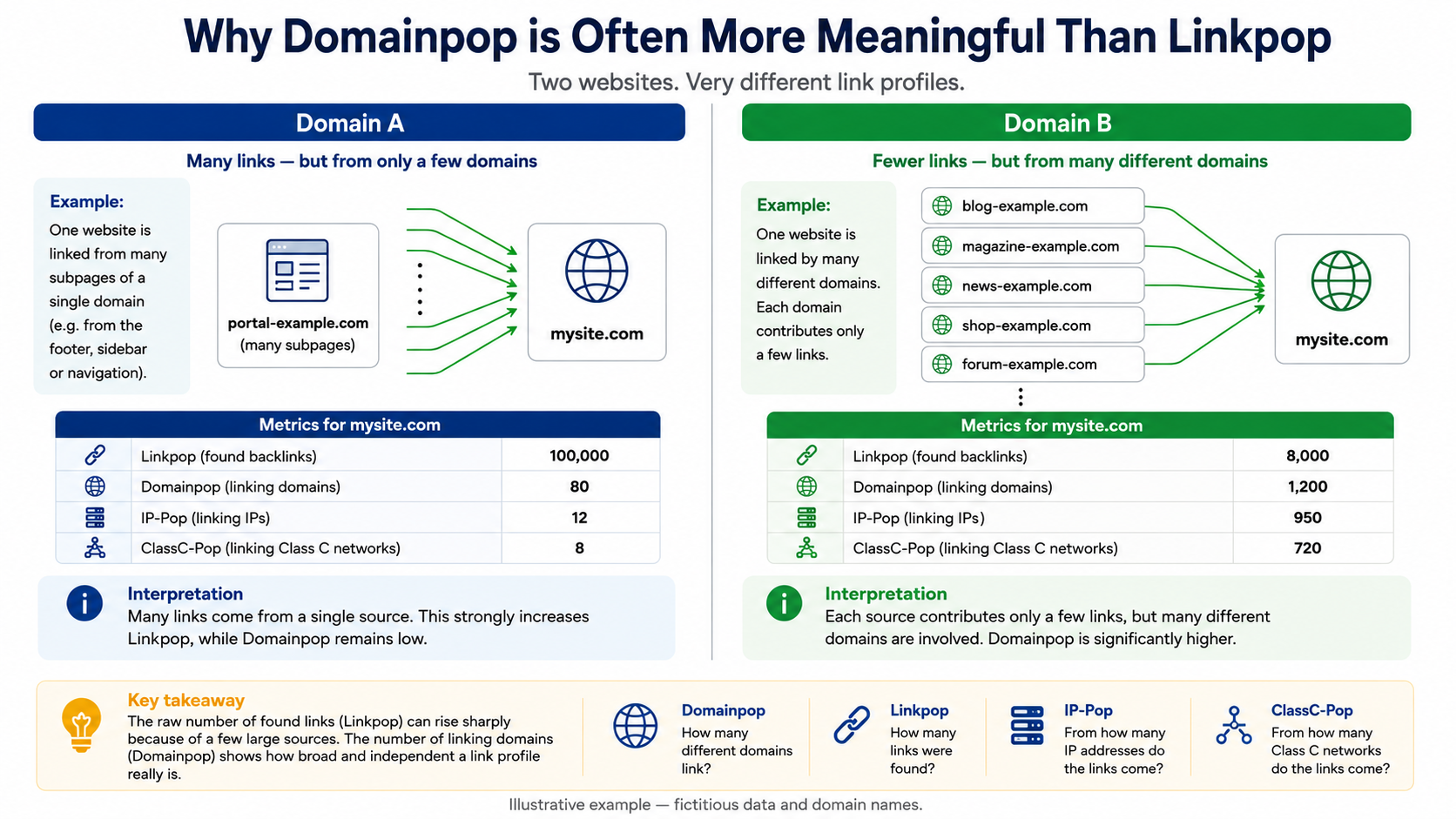
Linkpop: Number of Found Links
Linkpop describes, in simple terms, the number of found links pointing to a domain or URL.
If a website is linked from 10,000 subpages of another domain, this can strongly increase its Linkpop. This can be relevant, for example, to identify large sitewide links, technical linking patterns or unusual link sources.
But on its own, this number is not enough to evaluate how broad a link profile really is.
10,000 links from one domain are very different from 10,000 links from 10,000 different domains.
Domainpop: Number of Linking Domains
Domainpop counts how many different domains link to a domain or URL.
It therefore answers a different and often more important question: How broadly is a domain linked across the web?
A high Domainpop usually indicates that many different websites are linking to a domain. For many SEO analyses, this is more meaningful than simply counting all individual links.
Example:
- Domain A has 100,000 found backlinks from 80 domains.
- Domain B has 8,000 found backlinks from 1,200 domains.
Based only on Linkpop, Domain A appears stronger. Looking at Domainpop, however, Domain B has the much broader link profile.
Why Both Metrics Matter
Domainpop and Linkpop should not be seen as competing metrics. They answer different questions.
Linkpop helps identify the volume of individual links. It can point to sitewide links, large portals, automated linking patterns or technical structures.
Domainpop, on the other hand, shows how many different websites are linking to a domain. It is therefore often better suited to assess the breadth and independence of a link profile.
It becomes especially interesting when both values differ significantly.
Very high Linkpop combined with low Domainpop can indicate a few very large link sources. High Domainpop with comparatively low Linkpop is more likely to suggest many individual and independent links.
IP-Pop and ClassC-Pop as Additional Signals
In addition to Linkpop and Domainpop, IP-Pop and ClassC-Pop can also be helpful.
IP-Pop shows from how many different IP addresses links were found. ClassC-Pop adds another perspective by looking at different Class C networks. These values can help put link profiles into context, especially when many linking domains are hosted on the same technical infrastructure.
These metrics are not decisive on their own either. But they provide additional signals about whether a link profile is broadly distributed or whether many linking domains are technically close to each other.
Conclusion
The raw number of found backlinks is often only a first indicator. For many analyses, Domainpop is more meaningful because it shows how many different domains actually link to a website.
High Linkpop can be caused by only a few large link sources. High Domainpop, on the other hand, usually points to a broader link profile.
In SEOkicks, these metrics can be reviewed together. Comparing Linkpop, Domainpop, IP-Pop and ClassC-Pop helps assess link profiles more realistically and identify unusual patterns more quickly.
0 Comments